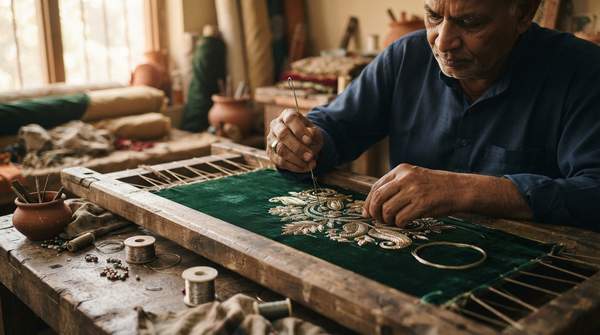
Zardozi embroidery is built from a surprisingly precise vocabulary. Its raised, gleaming surfaces are not produced by one thread but by a family of named components: springy coiled dabka wire, delicate salma, braided kalabattu, matte kora and shiny chikna threads, and star-shaped sitara sequins. Each material has a distinct job, and each is applied with two essential tools: the Adda frame that stretches the fabric drum-tight, and the Aari, a hooked needle that pulls metallic threads through from below. Understanding these names and their functions is the key to reading any piece of Zardozi and recognizing why it remains one of the world's most labor-intensive luxury textile crafts.
The Royal Threads: Zardozi's Persian Roots and Mughal Flourishing
The craft's own name records its origin. Zardozi combines Persian words for gold and embroidery, and accounts of the technique trace its roots to Persia before it traveled to India, where it reached its artistic peak under the patronage of the Mughal court. There, embroidery with gold and silver thread became a language of royal status, worked onto heavy fabrics substantial enough to carry the weight of metal embellishment.
That heritage shapes the craft's economics today. Writing on the practice, A M Lall notes that authentic Zardozi requires highly skilled artisans, weeks of manual work, premium materials, and traditional techniques passed down through generations. Each piece is entirely handcrafted — which is precisely why genuine Zardozi commands luxury prices and why buyers are, in effect, investing in the preservation of a centuries-old tradition rather than simply purchasing a decorated garment.
The craft's associations remain overwhelmingly ceremonial. Contemporary Zardozi pieces are made for weddings, formal events, and celebrations, continuing the pattern of royal patronage in modern commercial form. What has changed most dramatically is not the purpose but the material at the craft's heart.
From Gold to Gilt: The Evolution of Zardozi Materials
Historically, Zardozi meant metal: the craft was worked with genuine gold and silver thread, a tradition remembered in the term kalabatun for the braided metallic thread at the center of the technique. The intrinsic value of the thread once matched the status of the garments it adorned — the embroidery was, quite literally, precious metal laid onto cloth.
Modern Zardozi has adapted. Today's artisans work with more affordable metallic wires and gilt threads rather than solid gold and silver, a shift driven by economic reality that allowed the craft to survive even as the materials' intrinsic value declined. The aesthetic — raised, luminous, textured metal work — remained intact; only the metal beneath the surface changed.
The consequence for the observer is important: a contemporary piece of Zardozi may look indistinguishable from its precious-metal ancestors at a distance, because the visual effect depends on how wires are coiled, braided, and secured rather than on their bullion content. The craft's value now rests almost entirely on the skill of the artisan rather than the worth of the raw material — a fact reflected in descriptions of the work as a piece of living heritage.
The Artisan's Canvas: Tools of Zardozi Embroidery
Every Zardozi design begins with the Adda, a wooden frame typically built from four adjustable wooden bars. The cloth is stitched onto the two horizontal bars, stretched, then fixed tightly and locked onto the two vertical bars. This tension prevents the fabric from moving while the artisan works and allows clear vision along with faster movement of the tools — essential when heavy metallic wires are being pulled repeatedly through the cloth.
The Adda's design has an unassuming lineage. According to the Embroiderers' Guild of America, the frame was modeled on bed frames, and that basic form is still used today. Artisans sit on the floor around the Adda, and there is usually room for several of them to work on a single design simultaneously — a communal arrangement that suits the weeks of labor a large commission demands. A closely related frame described in accounts of Banaras work is called the karchob, which gives that regional tradition its name.
The second essential tool is the Aari needle, described as an awl with a hook at the end, similar to a crochet hook, with a wooden handle at the back. Accounts of the craft specify a number 10 needle for Zardozi work. Its hooked design matters: the Aari makes it much easier to work both sides of the fabric at once, catching metallic threads, wires, and beads from below the cloth while the artisan builds raised motifs on the surface.
A Symphony of Textures: Understanding Zardozi's Metallic Threads
What distinguishes Zardozi from other metallic embroidery is the sheer vocabulary of materials artisans draw on, each with its own texture and purpose. The threads are not interchangeable; a reader who learns the names can begin to see how a design's texture is constructed, layer by layer.
Dabka is a fine, springy coiled wire that produces a matte raised line, and it is the workhorse for building texture and volume in a design. Salma is finer and more delicate — described both as a fine coiled thread and as a hollow zig-zag wire — and is used for outlining, providing a distinct textural effect against dabka's bulk. Gijai is a thin, stiff wire reserved for crisp detailing, while tikora is tightly, spirally twisted gold thread used in intricate linework.
Kalabattu — the modern descendant of the historical kalabatun — is gold or silver wire wound onto a silk core; braided varieties serve borders, with thicker versions edging heavy fabrics and finer ones forming tassels and drawstrings. Two finish variants work as a pair: kora, a plain, lustreless matte thread, and chikna, a high-shine metallic thread, are often used together deliberately so that the contrast between dull and lustrous surfaces becomes part of the design itself.
Beyond Threads: Embellishments and Their Purpose
The metallic vocabulary extends beyond wires to discrete ornaments. Sitara, also called tikki, are tiny star- or disc-shaped metal sequins, typically placed at floral centers and as accents across a motif. Katdana and poth are cut-glass and pearl beads respectively, adding points of light and irregular texture among the metal work.
Authentic Zardozi also incorporates non-metallic richness: glass beads, freshwater pearls, crystals, and semi-precious stones such as black onyx, garnet, rose quartz, tiger's eye, and labradorite in more contemporary pieces. All of this is worked alongside silk thread onto substantial bases — velvet, silk, or satin — fabrics strong enough to carry the cumulative weight of metal and beadwork without distorting.
The table below gathers the craft's essential components into a single reference, connecting each name to its function and characteristic effect.
The Zardozi Artisan's Toolkit: Materials and Their Functions
This framework categorizes the core tools and named materials, showing how each contributes to the raised, metallic appearance that defines the craft. Read down the function column to see the division of labor: the tools create the working conditions, the wires build structure, and the embellishments add sparkle.
| Component | Type | Function and characteristic effect |
|---|---|---|
| Adda | Tool | Wooden frame that stretches the cloth drum-tight, preventing movement and enabling clear vision; artisans sit around it on the floor, historically modeled on bed frames |
| Aari | Tool | Hooked needle that catches metallic threads and beads from below the fabric, making it easier to work both sides of the cloth at once |
| Dabka | Material | Fine, springy coiled wire used to build texture and volume; produces a matte raised line |
| Salma | Material | Fine, delicate coiled thread or hollow zig-zag wire used for outlining; gives a distinct textural effect |
| Gijai | Material | Thin, stiff wire used for crisp detailing |
| Kalabattu | Material | Braided gold or silver thread, or wire wound onto a silk core; thicker versions for borders, finer ones for tassels and drawstrings |
| Kora | Material | Plain, lustreless matte thread; contrasted with shiny threads for varied effects |
| Chikna | Material | High-shine metallic thread; used with kora to add luster through contrast |
| Sitara (tikki) | Material | Tiny star- or disc-shaped metal sequins for floral centers and accents |
The pattern that emerges from this model is that Zardozi texture is engineered, not accidental. Matte and shiny threads are paired deliberately; bulky coiled wires create raised volume while finer zig-zag wires trace outlines; and discrete sequins punctuate the metallic field. A design's overall character can be decoded by asking which combination of these components dominates its surface.
Appreciating Zardozi: Identifying Craftsmanship and Materials
When encountering Zardozi embroidery, observe the distinct textures and metallic elements to identify the specific materials and tools used in its creation. The presence of coiled wires (dabka), fine threads (salma), braided elements (kalabattu), or star-shaped sequins (sitara) indicates the application of specific Zardozi techniques and materials. A surface you can now name — matte raised lines, zig-zag outlines, alternating dull and lustrous threads — is evidence of an artisan who sat at an Adda for weeks, working each element with a hooked Aari needle by hand.
Sources
- What Is Zardozi Embroidery? A Complete Guide to India's Royal Hand Embroidery — Zardouzee by Alark Lall
- Zardozi Embroidery: History, Techniques & Indian Craft — Dash & Twine
- Client Challenge — SCRIBD
- Embroidery Technique from Around the World: Zardozi — Embroiderers’ Guild of America
- Zari-Zardozi~Bhopal - Craft Archive — Craft Archive | Research on Indian Handicrafts & Handloom - Indian Craft online