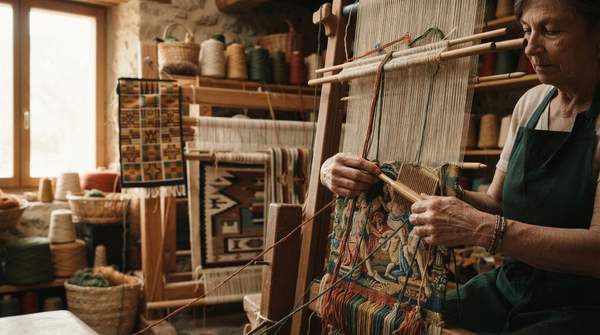
Tapestry weaving is a weft-faced textile art in which dyed weft threads are interlaced through a hidden warp to build images rather than patterns, and the world's major traditions can be told apart by three practical clues: the loom's orientation, the structure of the fabric, and the finished textile's use. European Gobelins tapestry was woven on both vertical high-warp and horizontal low-warp looms with discontinuous wefts forming elaborate pictorial scenes. Ghanaian Kente is woven in narrow strips on a horizontal loom and stitched edge to edge into broad cloth. Navajo weavers work upright looms with continuous warp, producing tapestry-weave blankets and rugs in wool. Understanding these choices turns a tapestry from a picture into a legible technical document.
What is Tapestry Weaving? A Definition and Distinction
Tapestry is a form of textile art traditionally woven by hand on a loom, and it is normally used to create images rather than patterns. The defining structural feature is that the weaver interlaces dyed weft threads of various colors through columns of undyed warp threads, completely covering the warp in the process. The image lives entirely in the weft; the warp serves as a hidden skeleton.
This construction distinguishes tapestry from embroidery, a different technique in which decorative stitches are applied to a ground cloth that already exists. The confusion is common enough that large embroidered pieces with images are sometimes loosely called tapestries. The most famous example is the Bayeux Tapestry, which is in fact embroidered, not woven. The distinction matters because the two techniques represent fundamentally different processes: tapestry creates the fabric and the image simultaneously, while embroidery decorates a fabric made beforehand.
Not every tapestry tradition behaves identically, however. While European tapestry was typically made to be viewed from one side, other traditions, such as Chinese kesi and that of pre-Columbian Peru, make tapestry to be seen from both sides. The definition, then, is structural rather than geographic: a weft-faced, image-bearing woven cloth.
Ancient Origins and European Evolution
Tapestry's European ascent was gradual and institutional. From the Middle Ages onward, European tapestries could be very large, with images containing dozens of figures, and they were often made in sets so that a whole room could be hung with them. Weaving guilds had emerged in Europe by the eleventh century, an organizational development that established the intricate techniques and terminology still used today.
The tradition's golden age arrived under royal patronage. The Gobelins Manufactory, established in Paris in 1663 during the reign of Louis XIV, marked a pinnacle in tapestry production, employing over 800 artisans. In this era tapestries became even more elaborate, symbolizing royal prestige and influence. The scale of the enterprise was matched by the scale of the equipment: in the seventeenth century, the production of large tapestries required huge looms.
Two disruptions followed. The French Revolution and the invention of the Jacquard loom in the nineteenth century introduced significant changes, making tapestries accessible to a broader audience while preserving their status as works of art. Later, the Industrial Revolution reduced the prevalence of hand weaving generally, but a revival began in the twentieth century, driven particularly by cultural traditions and a push for self-sufficiency. Hand tapestry weaving never disappeared; it repositioned itself as art.
The Gobelins Tradition: European Mastery
European tapestry production used two loom types, and the difference is one of ergonomics rather than structure. The warp threads were stretched either vertically, on a high-warp loom, or horizontally, on a low-warp loom. On a high-warp loom, the weaver sits behind the vertical warp threads, while on a low-warp loom, they lean over the horizontal threads; in both instances, the weaver works from the back of the tapestry.
On the vertical loom, the warp was attached to rollers top and bottom, allowing the tapestry to be rolled down as work progressed. The design, known as a cartoon, was usually based on a smaller model prepared by the designing artist and was placed close to the weaver—sometimes even behind, with the weaver viewing it using a mirror. The weft itself was transferred from a spool to the weaver's main tool, called a bobbin or "broche," which could hold a single color or a combination of colorful threads twisted together.
The crucial point is that the tapestry structure remains the same regardless of loom: the choice affected the weaver's position and process, not the finished textile's appearance. What defines the Gobelins cloth is weft-faced weaving with discontinuous wefts—separate colored areas joined within the fabric—which allows detailed pictorial representation of elaborate scenes hung on walls as statements of prestige.
Kente Cloth: Ghanaian Weaving Heritage
Kente follows a completely different logic of construction. Woven by the Ashanti and Ewe peoples of Ghana, it is produced in narrow strips on a horizontal loom, then stitched edge to edge into broad cloth. The horizontal strip loom imposes the tradition's defining constraint: no single weaving produces a wide textile. Width is achieved by assembly, and the seams between strips are part of the cloth's character rather than a flaw to hide.
Historically Kente was reserved for royalty and ceremony, and it functions as a readable text as much as a garment. Every pattern and color combination carries specific meaning, encoding history, proverbs, ethics, and political thought—so a Kente cloth can be read as much as worn. The geometric patterns are therefore not decoration alone but carriers of cultural information.
The tradition's standing received formal recognition recently: in December 2024, UNESCO inscribed the craftsmanship of Kente on its Representative List of the Intangible Cultural Heritage of Humanity, Ghana's first inscription under that convention. The recognition was aimed at the weaving knowledge and how it passes down, rather than at the cloth alone.
Navajo Weaving: North American Artistic Expression
Navajo weavers in the United States work upright looms with continuous warp, producing tapestry-weave blankets and rugs in wool. Like the European high-warp loom, the upright loom orients the warp vertically, and the weaver typically works from the bottom up. Unlike the European tradition, the warp is continuous—threaded so that the finished textile can be cut from the loom without its structure unraveling.
Structurally, Navajo weaving shares tapestry's essential weft-faced character: the weft completely covers the warp, and designs are built by interlocking wefts or by slit tapestry, where adjacent color areas turn around separate warps and are joined only at the points where the weaver links them. These techniques are integral to forming the distinct geometric patterns for which Navajo textiles are known.
The tradition's output also differs in function. Where Gobelins tapestries hung on walls as pictorial statements, Navajo tapestry-weave textiles were made as blankets and rugs—functional objects whose artistry is inseparable from their use.
Comparative Overview of Tapestry Traditions
The table below compares the three traditions across consistent dimensions. The pattern it reveals is that loom orientation and weft handling—continuous versus discontinuous, single cloth versus assembled strips—drive each tradition's visual identity and cultural use.
| Tradition | Loom Type | Key Structural Feature | Typical Imagery/Use |
|---|---|---|---|
| European (Gobelins) | Both high-warp (vertical) and low-warp (horizontal) looms; weaver works from the back | Weft-faced weaving with the weft completely covering the warp; discontinuous wefts allow intricate pictorial designs | Elaborate pictorial scenes, often in sets hung to cover whole rooms; symbols of royal prestige |
| Ghanaian (Kente) | Horizontal strip loom, producing narrow strips | Narrow woven strips stitched edge to edge into broad cloth; weft-faced | Geometric patterns and symbolic motifs encoding history, proverbs, ethics and political thought; historically royal and ceremonial garments |
| North American (Navajo) | Upright loom with continuous warp; weaver works from the bottom up | Weft-faced tapestry weave, using interlocking wefts or slit tapestry to form designs | Geometric blankets and rugs in wool |
Read across the rows, the comparison shows that the loom choice shaped process rather than product in Europe—the Gobelins structure stayed constant whether the weaver sat behind a vertical warp or leaned over a horizontal one. In Ghana, the horizontal strip loom made assembly the defining act, and in North America the continuous warp on an upright loom suited the production of durable, functional textiles. Each technical decision left a visible signature in the finished cloth.
Appreciating Tapestry: Beyond the Image
When encountering a tapestry, consider its technical construction and historical context to fully appreciate its cultural significance and artistic achievement. The measurable test of that appreciation is the ability to identify the loom type—vertical, horizontal, or strip—or the key structural features, such as discontinuous wefts or sewn strips, that define a tapestry's tradition. A cloth whose width is built from stitched narrow strips points to Kente and its encoded meanings; a large pictorial hanging points to the European weft-faced tradition and its royal workshops; a woolen blanket woven bottom-up on a continuous warp points to Navajo practice. The loom, in each case, is visible in the textile long after the weaving is done.
Sources
- Tapestry - Wikipedia — EN
- Tapestry Fabrics: A Weaving Tradition Woven Through Time — Ecclesiastical Sewing
- Making Tapestries — Clarkart
- Tapestry - Harley Foundation
- Client Challenge — Khanacademy
- History of Weaving: Techniques, Looms & Types — ADORNO DESIGN
- Weaving | History | Research Starters — EBSCO