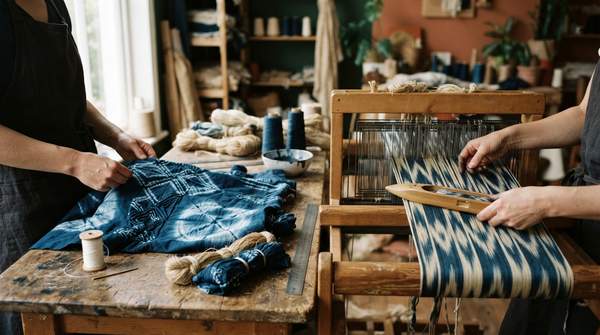
The difference between shibori and ikat comes down to one decision in the production sequence: what stage of the textile the dye resist touches. Shibori is a Japanese resist-dyeing tradition in which finished, woven cloth is bound, folded, stitched, twisted, or compressed before it enters the dye bath. Ikat works the opposite way — the resist is applied to the threads themselves, warp or weft or both, before they are ever woven into fabric. That single procedural difference explains nearly everything about how the two fabrics look and feel.
Shibori: Manipulating Woven Cloth for Unique Patterns
Shibori, as the dye supplier Dharma Trading explains, is a Japanese term for methods of dyeing cloth with a pattern by binding, stitching, folding, twisting, or compressing it — the family of techniques broadly known as tie-dye. The name traces to the Japanese root "shiboru," meaning to wring, squeeze, or bind, as Jessica Kaufman of Waxon Studio notes. The earliest known cloth dyed with a shibori technique dates from the 8th century.
The process starts with a piece of finished cloth. The artisan then physically shapes it: sections are folded, rolled, knotted, twisted, looped, or cinched with string and thread. Writing for DARIA magazine, Laura I. Miller describes artisans using everything from rods to wax, seeds, and pebbles to force the cloth into three-dimensional forms. Wherever the fabric is compressed or covered, dye cannot reach it; when the cloth is unfolded, the protected areas remain the original color while the exposed areas take the dye. The result, as Miller observes, is "natural flaws that, in contrast to printed patterns, capture unique traces of the artisan's hands."
Ikat: Dyeing Threads Before the Weave
Ikat reverses the order of operations. The word comes from the Indonesian "mengikat," meaning "to tie" or "to bind," and has come to describe both the process and the cloth itself. In ikat, a resist similar to tie-dye is used on either the warp or the weft threads before they are woven, creating the pattern in the yarns rather than on the finished cloth. When both the warp and the weft yarns are tie-dyed before weaving, the result is called a double ikat, a form documented in India, Guatemala, Japan, and parts of Indonesia.
The mechanics are exacting. Segments of yarn are tightly bound with resist material, keeping the covered sections in their original color, and the bound threads are dipped into a dye bath. For multi-colored patterns, the bindings are removed and new ones are tied before the yarn goes into a different dye bath, as described by the fabric retailer Velvetica. Only then do the dyed threads go onto the loom, where the weaver aligns them so the pattern emerges during weaving. The George Washington University Museum and The Textile Museum describes this as "a meticulous practice of selectively binding and dyeing threads before weaving" — a process demanding enough that ikat fabrics became potent symbols of wealth and high status in many cultures.
Shibori vs. Ikat: A Comparative Overview
Juxtaposing the two techniques across their process variables isolates the defining difference: in shibori, resist is applied to the woven cloth after weaving; in ikat, it is applied to the yarns before they are woven into cloth. Every other distinction flows from that timing.
| Characteristic | Shibori | Ikat |
|---|---|---|
| Technique stage | Resist applied to the fabric after it has been woven | Resist applied to the warp and/or weft threads before they are woven |
| Material treated | The woven cloth itself is manipulated and dyed | Individual warp or weft threads (or both) are resist-dyed before assembly on the loom |
| Resist method | Folding, binding, stitching, twisting, or compressing sections of the cloth, sometimes around rods, seeds, or pebbles | Sections of threads tightly bound with resist material before dye baths; bindings removed and reapplied for multi-color patterns |
| Characteristic pattern | Sharper-edged shapes that record the physical manipulation of the cloth and traces of the artisan's hands | A distinctive "blurry" or feathered edge, caused by slight misalignment of dyed threads during weaving |
The comparison also clarifies a common confusion: shibori belongs to the same broad family as tie-dye, and Fabric Sight's Andrea Raumer identifies shibori as the best-known version of tie-dye, which binds sections of finished fabric. Ikat, by contrast, shares the binding logic but moves it upstream to the yarns. As The Craft Atlas puts it, in other resist techniques like tie-dye, the resist is applied to the woven cloth, "whereas in ikat the resist is applied to the yarns before they are woven into cloth."
Visual Outcomes: From Crisp to Feathered
Each technique announces itself in the finished textile. Because shibori patterns are shaped directly in the cloth, their edges reflect the physical boundaries of folds and bindings — defined shapes bearing the imprint of the hands that made them. The irregularities are not defects; they are the signature of the process.
Ikat's look is the consequence of its difficulty. The pattern exists only as dyed segments along individual threads, and it materializes only if the weaver can line up each thread precisely with its neighbors. The Craft Atlas attributes ikat's characteristic "blurriness" to "the extreme difficulty the weaver has lining up the dyed yarns so that the pattern comes out perfectly in the finished cloth" — a hallmark that can be reduced with finer yarns or greater skill but never fully eliminated in hand work. Because the design is created in the yarns rather than on the surface, an ikat pattern reads on both faces of the fabric, looking the same on front and back, unlike a surface-printed cloth.
Identifying Shibori and Ikat: A Key Distinction
To identify either textile, ask the single diagnostic question: was the resist applied to the woven fabric or to the threads before weaving? The presence of sharp, manipulated patterns on finished cloth indicates shibori, while blurred or feathered pattern edges suggest ikat's pre-woven thread dyeing. Examining whether the pattern appears identically on both faces of the fabric offers a quick confirmation of ikat's woven-in design.
Sources
- Did You Know... About Ikat and Shibori? — Dharma Trading Co.
- What is Shibori Dyeing? — Waxon Batik & Dye Studio
- Resist: Tie Dye Practices Around the World — DARIA: Denver Art Review, Inquiry & Analysis
- What is Ikat Pattern? History & How to Style It — VELVETICA
- Ancient Resist Dyeing Techniques: Ikat & Tie-Dye — Fabric Sight
- What is Ikat? – The Craft Atlas