
The swirling teardrop known in the West as paisley began as the boteh (or buta) of ancient Persia, a motif whose exact origins remain contested by experts but whose symbolic weight is well documented. From there it traveled through Mughal India's shawl workshops, entered Europe through the East India Company's shawl trade, took its modern name from a Scottish weaving town, and was later claimed in turn by bohemians, hippies, rock musicians, and luxury fashion houses. At each stage, the pattern kept its distinctive droplet silhouette while shedding and acquiring meanings: from a sign of life, eternity, and rebirth, to a marker of luxury and exoticism, to an emblem of non-conformity and countercultural swagger.
The Ancient Roots of the 'Boteh': Persia and India
The motif's earliest chapters are written in uncertainty. The boteh jegheh, as the design is known in Persian, has ancient Indo-Iranian origins, but experts contest the time periods of its emergence, and accounts of its birthplace vary. What is broadly agreed is that the pattern, known as boteh or buta, has roots in both ancient Persia and India, with early designs found in places such as Balkh in modern-day Afghanistan, once part of the Persian empire. A twelfth- to fourteenth-century bronze ornament from Afghanistan held by the Los Angeles County Museum of Art is cited as a very early example of the paisley shape used ornamentally.
The symbolism attached to the boteh in Persian culture is rich and layered, though these interpretations are commonly cited theories rather than settled fact. One account holds that the motif depicts a cypress tree and flames, symbolizing rebirth and new beginnings, because the seeds of the cypress plant require fire to germinate, bringing new life to scorched ground like a phoenix rising from the ashes. Others argue its origins stem from old religious beliefs, with the shape symbolizing the sun, a phoenix, or an ancient Iranian religious sign for an eagle.
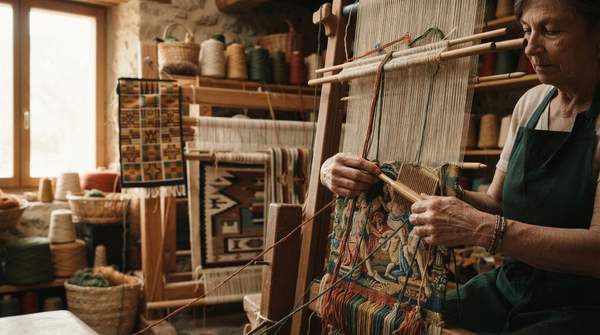
Whatever its precise origin, the boteh became an emblem of status in Iran. A floral version of the pattern gained popularity there as a decoration for royal objects, traditionally woven onto silk clothing using silver and gold thread. The motif was thus born at the intersection of craft and prestige, woven by hand into textiles that announced the wearer's elite standing.