Every flap, strap, and buckle on a classic trench coat started life as a solution to a soldier's problem. The garment that now signals understated city style was engineered for British officers facing rain, mud, and the need to carry equipment while staying mobile. Understanding that origin changes how you see the coat: it is not a design that happens to have details, but a set of details that happen to have survived.
The Fabric of Innovation: From Rubberized 'Macks' to Gabardine
Waterproof outerwear predates the trench coat by decades. As early as 1823, rubberized cotton was being used in weatherproof coats for both civilian and military use. These garments, known as "macks" after their inventor Charles Macintosh, kept rain out effectively—but they kept sweat in just as effectively. They also smelled unpleasantly distinctive and had a propensity to melt in the sun. Despite these flaws, British officers and soldiers wore Mackintosh's rubberized riding jackets throughout the 19th century, and the shortcomings of the fabric pushed clothiers to keep searching for something better.
The breakthrough came from Thomas Burberry, who invented cotton gabardine in 1879. As Sven Raphael Schneider explains in his trench coat guide, gabardine is a tightly woven worsted cotton that is both lightweight and durable, with both the yarn and the finished cloth waterproofed to achieve remarkable water-repellent properties. The practical difference matters. Where rubberized cotton trapped perspiration and degraded in heat, gabardine offered weather resistance without sacrificing breathability or comfort. For a soldier spending days exposed to the elements, that balance was the whole point.
This is the key to the coat's later success. The silhouette alone did not make the trench coat iconic; the material science underneath it did. A garment can only become a daily civilian staple if people can actually wear it comfortably—and gabardine made that possible in a way the earlier "macks" never could.
The Trench Coat's Functional Blueprint
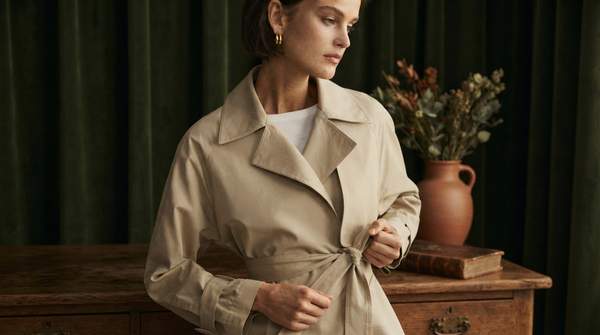
The clearest way to understand a trench coat is to take it apart, feature by feature. Each element below can be traced to a specific military requirement—weather protection, gear attachment, or freedom of movement—and the table shows how each one was carried into civilian wear. Use it as a diagnostic guide: the next time you see a trench coat, identify the parts and ask what each one originally did.
| Feature | Original Military Function | Civilian Adaptation |
|---|---|---|
| Epaulettes | Secured gas masks, gloves, or whistles on the shoulder—not merely indicators of rank | Retained as a signature military-style detail on the shoulder |
| Storm flap (gun patch) | Helped water run off the shoulder while adding ventilation; also cushioned and supported a rifle butt | Kept as a decorative overlap that still sheds rain from the shoulder |
| D-rings on the belt | Attachment points for military gear | Survive as a hallmark detail, even when nothing hangs from them |
| Cuff straps | Buckled tight at the wrist to keep water from running down the forearm—useful, as one account notes, when using binoculars in the rain | Still cinch the sleeve against wind and rain |
| Waist belt | Cinched the coat close to keep out the elements and anchored carried equipment | Defines the silhouette; still seals the coat against weather |
| Double-breasted closure | The overlapping front, traditionally ten buttons in a 6x2 cut, provided an extra layer of protection against the elements | The defining formal look of the classic trench coat |
| Raglan sleeves | Allowed greater freedom of movement for military activity | Continues to ease movement and give the coat its soft shoulder line |
| Gabardine fabric | Breathable, lightweight, water-resistant—solving the sweat-trapping flaws of rubberized cotton | Traditionalists, Schneider notes, still consider 100% cotton gabardine the only authentic choice |
Notice the pattern across the table. Nothing on the original coat was purely decorative, as Gloverall's editorial history of the garment puts it: everything had a purpose. The storm flap shed water and ventilated; the D-rings carried gear; the raglan sleeves freed the arms. Civilian fashion did not redesign the coat—it inherited it, keeping the features even after their military context faded.
It is worth being precise about what these features did not do. Accounts differ in emphasis: some describe the epaulettes primarily as rank display, while Schneider argues they secured gas masks, gloves, or whistles. The storm flap's primary job was water shedding and ventilation, with rifle support as a secondary use. Where the evidence is specific, the function was practical; where it is disputed, the honest answer is that a feature may have served several purposes at once.
Transition to Civilian Life: A Symbol of Experience and Style
How does a piece of military equipment become a civilian wardrobe essential? The first mechanism was simple ownership. When the war ended, many officers returned home with their trench coats in tow, according to Gloverall's account of the garment's history. The coat's durability and practical weather protection meant there was no reason to discard it—and every man wearing one on a city street had, by definition, served. The coat carried an implicit story of experience before it carried any fashion meaning at all.
The second mechanism was the coat's inherent suitability for civilian life. The same design brief that made it work in the trenches—long enough to protect from rain and mud, short enough for ease of movement—made it work for walking city streets, commuting, and traveling. It was a windbreaker and rain jacket, not heavy winter outerwear, which suited the unpredictable weather of everyday life. A garment engineered for miserable conditions turned out to be ideal for ordinary ones.
The third mechanism was cultural. In time, as Gloverall recounts, what began as military uniform evolved into a civilian staple, finding its way into city life and popular culture and quietly shedding its martial edge to become a symbol of elegance, practicality, and understated British style. The details that once carried grenades and gas masks became signifiers of taste. That reversal is the trench coat's real story: function became heritage, and heritage became style.
From Utility to Icon: The Trench Coat's Enduring Appeal
The trench coat deserves to be recognized not just as a fashion item, but as a garment whose design integrity is rooted in its functional military origins—what survives on the coat today is not decoration but a working blueprint, retained because it worked. Recognize that lineage, and the coat becomes a versatile and historically rich wardrobe staple rather than merely a look.
Here is the test of what this article has given you: the next time you observe a trench coat, you should be able to articulate the military purpose of at least three specific features—point to the storm flap and explain water shedding and ventilation, to the D-rings and explain gear attachment, to the cuff straps and explain sealing the sleeve against rain. If you can do that, you are seeing the garment the way its designers intended: every element answering a question the battlefield asked first.
Sources
- Trench Coat Guide: History, How To Wear, & Where To Buy — Gentleman's Gazette
- The History of the Trench Coat — Gloverall