You can recognize an Art Deco pattern in seconds: look for disciplined geometry, strict symmetry, and motifs like sunbursts and zigzags rendered with graphic precision. Once you know the handful of shapes behind the style, you can also apply it today without falling into period costume. The trick is adapting the geometry and the luxury, not copying a 1925 textile.
The Enduring Allure of Art Deco Patterns
Why does a style born in the 1920s still show up in packaging, interiors, fashion, and branding? Pattern Weaver, a pattern-design resource, puts it plainly: Art Deco patterns "communicate luxury, precision, and confidence through geometry alone." Clean lines arranged with mathematical order do the work that ornament once did.
That clarity is exactly what keeps the style commercially alive. The design commentary published by YourColors adds that the patterns evoke history and luxury "while simultaneously feeling fresh and modern," and that their structured beauty offers order in a complex world. In other words, the appeal is emotional as well as visual.
Defining Art Deco Patterns: A Visual Framework
How do you tell an Art Deco pattern from any other geometric one? The difference lies in discipline. Art Deco patterns prioritize order and symmetry with a strong graphic punch, according to YourColors' design guide. The shapes are simple and streamlined, arranged in balanced, repeating structures.
Luxury is the second test. The Interior Design Institute notes that the style pairs its geometry with high-end materials—chrome, lacquer, glass against soft velvets—so the pattern itself often carries a high-contrast, metallic or jewel-toned palette. The National Building Museum, writing on the style's centenary, adds another tell: "speed lines," horizontal bands creating motion, and motifs like fan shapes and stylized fountains or ferns in interiors from the Kennedy-Warren Apartments to Radio City Music Hall.
So when you evaluate a pattern, ask three questions. Is it symmetrical? Is it built from sharp, simplified geometry? Does it feel opulent rather than casual? Three yeses, and you are almost certainly looking at Art Deco's vocabulary.
Art Deco Pattern Identification Guide
Use this table as your field guide. Each row breaks a common motif into its geometric building blocks and its telltale character, so you can distinguish one from another at a glance.
| Motif | Defining Geometric Shapes | Key Characteristics | Historical Example Context |
|---|---|---|---|
| Sunburst / Ray Patterns | Radiating lines from a central point, often truncated into a half- or quarter-circle | Expresses optimism and energy; used as hero elements or repeating units in a grid | Pervasive in 1930s architecture, from the Chrysler Building's crown to cinema facades |
| Zigzags / Chevrons | Angled lines, V-shapes, and sharp angles, typically steep (60–90 degrees) | Dynamic, rhythmic, and symmetrical; precise and evenly weighted, often in high-contrast metallic palettes | A staple motif of 1920s Art Deco interiors, conveying machine-age order |
| Stepped / Faceted Forms | Rectangles, squares, and triangles arranged in tiered or layered structures | Reflects machine-made precision and a streamlined, often architectural aesthetic | Recognizable in Art Deco furniture, such as Emile-Jacques Ruhlmann's 1926 cabinet |
The distinctions matter in practice. Pattern Weaver's guide warns that casual chevrons appear in boho and mid-century contexts too—but Art Deco zigzags are exact, steep, and metallic. The precision is the signature.
Key Motifs of Art Deco Textiles
Sunbursts are the easiest to identify: rays bursting outward from a core, sometimes flattened into fans or quarter-circles. The National Building Museum points to Radio City Music Hall's carpet, with its radiating fan motif, as a classic example of the form in a textile context.
Zigzags and triangles supply the rhythm. They stack in parallel rows, giving fabric a sense of movement and machine-tooled regularity. Stepped forms borrow from architecture itself: squares and rectangles climbing in tiers, echoing skyscraper massing. Ruhlmann—described by Artsper Magazine as a genius of the movement—was known for extravagantly patterned carpets and vividly colored textiles and wallpaper alongside furniture that was simple in form but lavishly decorated. His 1926 cabinet remains, per that account, an example of easily recognizable Art Deco shapes.
Remember the sources of these shapes, too. YourColors notes that Art Deco artists reinterpreted East Asian, African, and Mesoamerican art through a modern lens, layered with Jazz Age energy, Hollywood glamour, and the rise of the skyscraper.
Art Deco in Modern Fashion
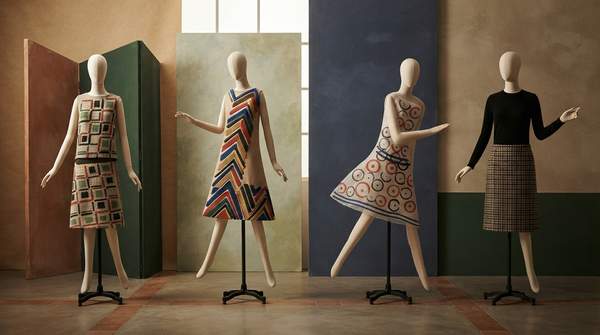
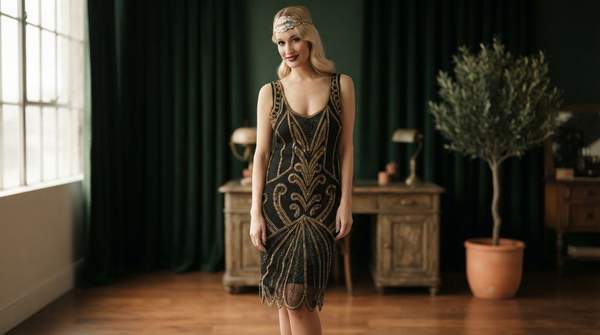
How do these century-old motifs stay wearable and livable rather than costume-like? By simplification and adaptation. YourColors argues that contemporary creators who understand the foundational principles can craft designs that are "both historically informed and vibrantly current"—which implies reworking the motifs with modern materials and cleaner treatments rather than reproducing period pieces.
In interiors, that means disciplined geometry applied through wallpaper, rugs, and upholstery, with contrast doing the heavy lifting: hard glass or chrome surfaces against velvet, as The Interior Design Institute recommends, creates depth without clutter. In fashion, it means letting a single motif—a radiating sunburst, a steep zigzag band—anchor a garment rather than decorating every surface.
Integrating Art Deco into Modern Aesthetics
To effectively integrate Art Deco patterns into contemporary fashion and interior design, focus on adapting core geometric motifs and principles of symmetry and luxury rather than replicating historical pieces. Choose one motif family from the table above, keep its geometry exact, and pair it with high-contrast or luxurious materials so the pattern reads as intentional rather than generic.
You will know the integration has worked when the specific motifs—sunbursts, zigzags, stepped tiers—are recognizable in the new design yet it feels modern and fresh, not merely nostalgic. That is your measurable test: if a viewer names the motif and still calls the result current, the balance is right.
Sources
- Art Deco Pattern Design: Geometry Meets Glamour — Pattern Weaver
- Art Deco Patterns: Geometric Glamour & 1920s Textiles | Your Colors
- The Interior Design Institute
- Art Deco at 100: The Enduring Influence of Design — National Building Museum
- The Most Beautiful Examples of Art Deco Patterns - Artsper Magazine