Upcycling turns textile waste into products of greater value or quality than the original item—and the practical question for any designer is not whether to upcycle, but how to match the material in front of you to the right technique. Research from North Carolina State University's Wilson College of Textiles, summarizing doctoral work by Hyesim Seo in textile technology management, identifies design techniques including patching, cutting, adding, and material mixing as the core moves used to build new designs from "limited and inconsistent materials." This article explains those techniques and gives you a decision framework for assessing any batch of textile waste before you commit to a project.
Introduction to Textile Upcycling: Transforming Waste into Value
What separates upcycling from ordinary recycling? According to the Wilson College of Textiles, citing research by Kamble and Behera published in 2021, upcycling is a recycling approach in which waste materials are developed into products of greater value or quality than the original product. This contrasts with downcycling, which produces recycled items of lower value.
In fashion specifically, upcycling is commonly understood as a design-based approach, as characterized by Aus and colleagues in research cited by the college. Think of discarded denim jeans transformed into unique patchwork apparel. The value is created by design decisions, not by industrial processing.
That distinction matters for you as a maker. Because upcycling is design-led, your skill in reading a material—its type, condition, and quantity—determines the outcome. A review of waste fabric upcycling examining trends and challenges over the past decade frames the practice as part of sustainable development, evaluating both environmental and economic impacts of upcycling initiatives. This article stays at that small-scale, creative level: it covers design-led techniques for individuals and small businesses, not industrial-scale chemical recycling.
Core Upcycling Techniques for Designers
Seo's dissertation, described by the Wilson College of Textiles, names patching, cutting, adding, and material mixing as the techniques employed in the upcycling design process. You can group these into three practical families.
Deconstruction and reconstruction. This is the broadest family: taking an existing garment apart, or cutting it, and rebuilding it into something new. The evidence supports it at the level of transforming old garments—denim jeans becoming patchwork apparel is the cited example—rather than as a detailed step-by-step process. The core idea is that the original garment's structure becomes raw material for a new one.
Surface transformation. Here the textile stays largely intact, and you modify its surface: patching and sewing onto existing fabric to create new designs. Seo's research describes designers who "experiment with sewing, patch work" as part of the process. This family suits materials that are structurally sound but visually plain or damaged in places.
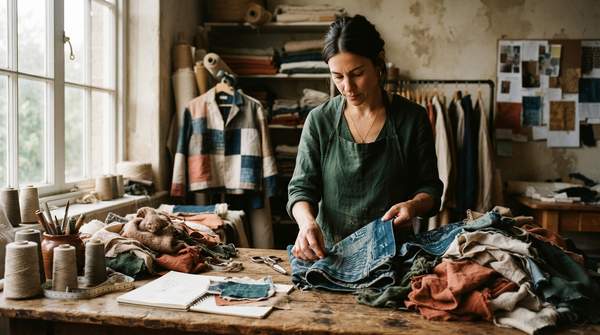
Material combination. This technique—directly named as "material mixing" in Seo's work—involves integrating leftover fabric scraps and unused textile pieces into a new textile or product. Instead of one garment as the starting point, the starting point is a pool of fragments combined into something cohesive.