
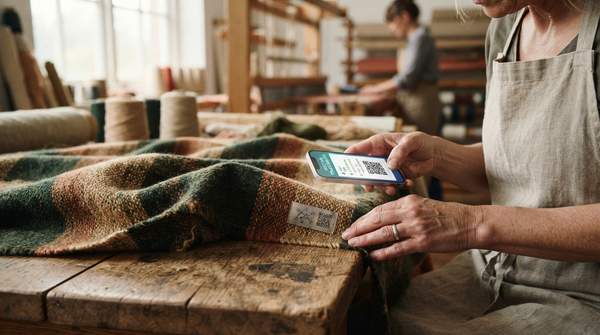
Blockchain addresses three distinct failures in the fashion supply chain with three distinct mechanisms: an immutable, decentralized ledger makes ethical and sustainability claims verifiable rather than taken on trust; cryptographic validation of every asset blocks counterfeit goods from passing as authentic; and real-time, network-wide logging of each step from factory to end user replaces opacity with traceable fact. The technology is not yet a holistic industry solution — a 2023 systematic review by Aayushi Badhwar, Saniyat Islam and Caroline Swee Lin Tan, published in Frontiers, found current uses in fashion and textiles limited to niche problems rather than the entire supply chain — but the mapping between specific problems and specific blockchain features is well established.
The Transparency Challenge in Fashion Supply Chains
Fashion's supply chains are structurally difficult to see through. Materials pass through multiple hands — growers, spinners, dyers, cut-and-sew factories, distributors — and traditional logistics systems often lack the transparency needed to trace product origins and verify authenticity, as supply chain researchers writing in the Journal of Theoretical and Applied Electronic Commerce Research describe. The consequences are concrete: consumers cannot inspect whether a sustainability or ethical claim is true, and brands cannot easily prove it.
The Frontiers review by Badhwar and colleagues frames the stakes in two directions at once. Counterfeit copies flood the market, damaging brand revenues and reputation while shaping consumer mindset; at the same time, European consumers and regulators increasingly demand sustainable, ethically sourced supply chains, and failure to demonstrate such practices can cost a brand its reputation and its customers' trust. The two pressures converge on one requirement: a record of a product's journey that outside parties can actually check.
Blockchain's Core Mechanisms for Supply Chain Solutions
Three features do the work. First, the ledger is decentralized and consensus-driven: no single party controls the record, and transactions are recorded immutably, meaning data cannot be altered once entered. Second, cryptographic security keeps every transaction and contract term verifiable, which is what prevents fraud. Third, smart contracts — automated agreements that execute when specific conditions are met — reduce delays and disputes between suppliers and distributors, as supply chain analyses of the technology explain.
Together these features solve what a procurement and supply journal review calls the information challenge of supply chain activities: traceability, transparency, security and smart execution in one system. When all partners access the same verifiable data, trust replaces friction and transparency replaces uncertainty. The first fashion-related application came in 2017, when designer Martine Jarlgaard partnered with the technology company Provenance on a pilot that tracked raw materials through the supply chain to the completed garment — an early demonstration that the concept works at garment scale, not just in theory.
Verifying Ethical Sourcing and Sustainability Claims
The ethical-sourcing problem is fundamentally an evidence problem. A brand can claim organic cotton or fair labor, but without a record the consumer can inspect, the claim is marketing. Blockchain's contribution is that companies can record and verify every stage of a product's supply chain — from raw material sourcing through production and distribution — giving consumers the means to make informed decisions and support brands aligned with their values.
The mechanism matters as much as the outcome. Because entries on the ledger cannot be altered once recorded, a certification logged at the raw material stage cannot later be quietly amended or contradicted. The Liverpool research on blockchain in fashion supply chains, examining information disclosure and sustainable coordination, finds that this traceability, transparency, security and smart execution is precisely what lets blockchain help solve the supply chain's information challenges — and thereby helps companies credibly showcase sustainable practices and uphold ethical standards, promoting environmental efforts and building consumer confidence in sustainability claims.
Combating Counterfeiting with Blockchain Authenticity
Counterfeiting is, in the Frontiers review's words, an unrelenting concern: counterfeit copies of authentic products flood the market, hitting brand revenues and reputation directly. Traditional systems struggle with authenticity verification because there is no tamper-proof link between a physical item and its legitimate history.
Blockchain supplies that link. Because records are difficult to alter and every asset is validated, counterfeit goods are prevented from entering the system in the first place — the cryptographic security ensures all transactions and contract terms remain immutable and verifiable, reducing the risk of counterfeiting and fraudulent activities. For the consumer, this means authenticity verification: the ability to confirm a product's provenance and ownership rather than rely on a label. The same academic review notes that the first use of blockchain in fashion-related supply chains was diamond trading, where researchers studied its value for authentication and certification — evidence that the anti-counterfeit mechanism predates and transcends any single product category.
Blockchain's Impact on Fashion Supply Chain Challenges
The table below maps each supply chain problem to the specific blockchain feature that addresses it and the benefit that follows, so the cause-and-effect relationship is visible rather than assumed. It distinguishes how different features solve distinct problems, moving past the general idea of "transparency."
| Supply Chain Challenge | Blockchain Mechanism | Resulting Benefit |
|---|---|---|
| Unverifiable ethical and sustainability claims | Decentralized, immutable, transparent ledger records transactions and events, ensuring data integrity; data cannot be altered once recorded | Companies can credibly demonstrate ethical practices, promoting environmental efforts and enhancing consumer trust in sustainability claims through verifiable records |
| Counterfeit products, which erode consumer trust and brand revenue | Difficult-to-alter records validate every asset; cryptographic security prevents fraud | Consumers can verify product authenticity, reducing fraudulent activity and enabling real-time tracking and verification |
| Lack of end-to-end transparency | Real-time tracking logs each step from factory to end user across a viewable network, recording every transaction and event in the supply chain | All partners access the same verifiable data; trust replaces friction and transparency replaces uncertainty |
Tracing a Garment's Journey: From Raw Material to Consumer
How does this look in practice? The evidence describes the stages rather than a single garment's complete data trail, so the sequence below reflects what the sources support at each point. At the raw material stage, sourcing events and certifications are recorded on the ledger — the approach the 2017 Jarlgard–Provenance pilot used to track raw materials through the supply chain to the finished garment. Through production and distribution, blockchain lets companies record and verify every stage of the product's chain, so claims made at origin remain anchored to an unalterable record.
In logistics, each step — from factory to warehouse to end user — is automatically logged and viewable across the network, and smart contracts execute automatically when conditions are met, reducing delays and disputes between suppliers and distributors. At the retail end, the consumer-facing payoff arrives: transparency lets consumers inspect the sustainability and ethical claims of a product, and traceability lets them verify its authenticity and ownership. The garment's story becomes a checkable record rather than a marketing narrative.
Limitations and Challenges to Blockchain Adoption in Fashion
The honest caveat is scale. The Frontiers systematic review states that in the fashion and textile industry, blockchain is yet to be applied to the entire supply chain, with current uses limited to solving niche problems rather than providing a holistic solution for traceability and transparency — and limited experimental exploration of the technology's features has left countless challenges unresolved. This is a current state of adoption, not an inherent technological barrier.
Resources compound the problem. Fashion Revolution's analysis of blockchain for supply chain transparency notes that much research and development is happening in the fintech space, driven by the early successes of cryptocurrencies, and it will be hard to sway software developers toward industries with smaller budgets than finance. The organization suggests brands and governments with strong garment sectors attract university talent and sponsor case competitions to build the pool of developers drawn to challenges such as reducing forced labor in the supply chain. Research on implementation economics likewise stresses exploring the cost threshold at which blockchain benefits all parties in the chain — a question the fashion sector has not yet answered at scale.
Navigating Blockchain Adoption in Sustainable Fashion
Fashion industry stakeholders should consider blockchain technology as a viable tool for enhancing transparency, verifying ethical sourcing, and combating counterfeiting, while acknowledging current implementation challenges. The evidence supports targeted deployment: the mechanisms are proven for specific problems — verifiable claims, authenticated products, logged logistics steps — even though whole-chain coverage remains out of reach today.
The measurable indicator to watch is increased adoption of blockchain solutions for specific supply chain segments, alongside the development of more holistic, industry-wide frameworks. When a brand can show a consumer a ledger-backed record running from raw material certification to point of sale — as the 2017 pilot demonstrated in miniature — the technology will have moved from niche experiment to industry infrastructure.