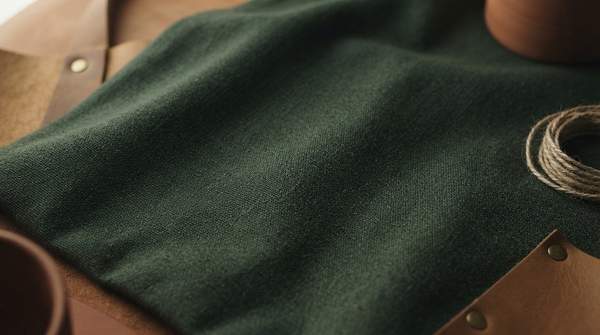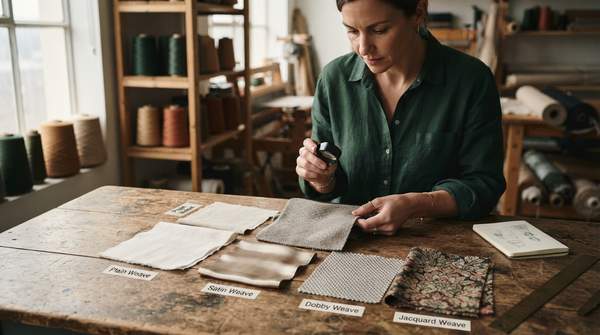
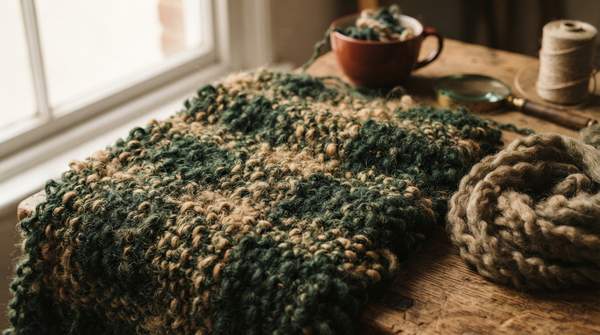
That soft, springy warmth in a wool sweater is not an accident of the yarn. It begins with the shape of individual fibers. Crimp—the natural waviness along a single fiber's length—is the microscopic structure that traps insulating air, gives fabric its bounce and elastic recovery, and creates loft. The same structure, however, works against smoothness, lustre, and drape. Understanding that trade-off lets you predict how a fabric will perform before you buy it.
The Hidden Architecture of Fabric: What is Fiber Crimp?
Crimp is the zig-zag waviness built into an individual fiber. Textile scientists at the Nonwovens Institute define it geometrically: crimp frequency is the number of waves per unit length, and crimp can also be measured as the percentage difference between a fiber's straightened length and its crimped length. In other words, crimp is a measurable geometry, not just a texture.
Where does it come from? In wool, the most prominent example, the structure originates in the fiber's biology. As the bedding maker Woolstar explains, wool fibers are made up of two distinct cell types that grow at slightly different rates. That uneven growth causes the fiber to bend—and the bend becomes the crimp.
Why does this matter to you? Because the number of waves per centimeter shapes everything the finished fabric does: how warm it is, how it springs back, and how full it feels in the hand.
Crimp's Role in Thermal Insulation: Trapping Warmth
Still air is a poor conductor of heat, and crimp is a machine for holding still air. The waves prevent fibers from packing flat against one another, so air pockets form within the fiber mass and throughout the yarn. The more crimp per centimeter, the more air the fiber can trap, which is what regulates temperature and gives wool products their soft, full feel.
This is why crimped fibers excel in insulation. A smooth, straight fiber lies down densely; a crimped fiber stands off its neighbors, holding an open, porous structure. The warmth you feel is not the fiber itself—it is the air the fiber's geometry refuses to let go.
The same principle applies whether the fiber ends up in a duvet, a sweater, or a blanket. High crimp frequency means more trapped air per gram of fiber, and more consistent warmth through the fabric.
Elasticity and Loft: The Spring-Like Nature of Crimped Fibers
Crimp also behaves like a mechanical spring. The Nonwovens Institute's technical definitions treat crimp as a response to force: crimp recovery measures how much of the straightened fiber's length returns after a load is removed, and crimp stability measures how much of that contraction survives treatment. A fiber with strong crimp recovery resists being flattened and pushes back to its original shape.
At the fabric level, that spring action translates into properties you can feel. Woolstar credits crimp with wool's elasticity and resilience, its loft and bounce, and its softness and flexibility. When you crush a crimped fabric and release it, the fibers uncoil and the material regains its volume.
Loft follows from the same geometry. Because crimped fibers cannot align in parallel, they build a bulky, open yarn structure rather than a compact one. The fabric feels fuller and holds that fullness over time, which is why crimp-rich fibers suit bedding and outerwear where body and bounce are wanted.
The Trade-Offs: Crimp vs. Smoothness, Lustre, and Drape
Here is the catch: crimp is not free. How a fiber is spun into yarn determines how much crimp survives, and that choice trades one set of qualities for another.
So a yarn spun to keep its crimp gives you insulation, body, and recovery, but the fabric will be more matte and stiffer, resisting the fluid fall of a fine drape. A yarn spun with fibers aligned parallel produces a smoother, more lustrous cloth that drapes beautifully—but with less trapped air and less bulk. This is why a lofty sweater and a draping shawl can come from the same fiber and behave completely differently.
Crimp's Influence on Fabric Performance: An Explanatory Model
You can use crimp as a diagnostic tool. The causal chain runs from geometry, through physical mechanism, to the fabric property you observe. Trace it in either direction:
| Crimp Characteristic | Physical Mechanism | Resulting Fabric Property |
|---|---|---|
| Natural waviness (zig-zag geometry) | Fibers cannot pack flat; open structure forms | Foundation for all crimp-driven properties |
| High crimp frequency | Air pockets trapped within fiber mass and yarn | Thermal insulation; temperature regulation |
| Spring-like wave structure | Mechanical spring action; fibers return to shape after load | Elastic recovery, resilience, shape retention |
| Waves resist parallel alignment | Bulky, open yarn structure | Loft, bulk, fullness, bounce |
| High crimp retention (woollen character) | Fibers stay disordered in the yarn | Bloom and softness, but matte surface and stiffer drape |
| Reduced crimp, aligned fibers (worsted character) | Compact, parallel yarn structure | Smoothness, lustre, and drape, at the cost of insulation and loft |
Read the table top to bottom and you see why crimp-rich fabrics are warm and springy. Read it bottom to top and you can work backward from a fabric's feel to its likely fiber structure. A fabric that is lofty, matte, and springy points to retained crimp; a fabric that is smooth, lustrous, and fluid points to aligned fibers.
Selecting Textiles: Matching Crimp to Your Needs
When choosing textiles, consider the balance you want between warmth, stretch, and bulk on one side, and smoothness, lustre, and drape on the other—these properties flow directly from the fiber's natural crimp and how much of it the spinning process retained. Ask what job the textile must do before judging whether crimp is a virtue or a cost.
The tactile feel and visual appearance of a fabric—its springiness, loft, smoothness, and drape—will indicate the degree of crimp present and its functional implications. Squeeze a candidate fabric and watch it recover; hold it up and watch how it falls. Those two observations tell you where it sits on the crimp spectrum, and whether it belongs in your winter bedding or your next draped garment.