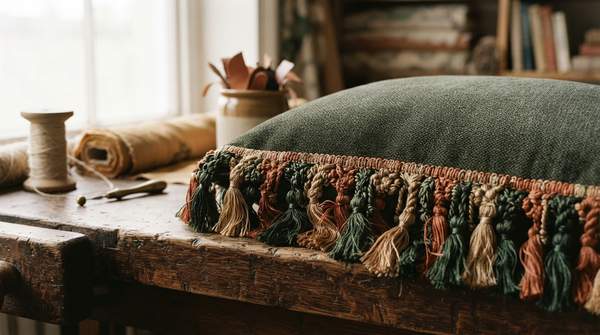
The textiles that most effectively connect a home to nature are breathable natural fibers—linen, organic cotton, and wool—combined with patterns that mimic organic forms, layered so that touch, sight, and even the sense of warmth reinforce one another. That is the practical answer this guide unpacks. Rather than treating "natural fabrics" as a single category, the framework below separates each textile by what it actually contributes to a biophilic room, where it works best, and how to verify its sustainability.
Understanding Biophilic Design in Textiles
Biophilic design is the practice of deliberately building people's connection to the natural world into interior spaces. The design consultancy Terrapin Bright Green, whose "14 Patterns of Biophilic Design" framework is widely cited in the field, places "highly textured fabrics/textiles that mimic natural material textures" among its constructed examples of nature-connection elements, alongside textured stone, wood, and fur. In other words, textiles are not a decorative afterthought in biophilic design—they are one of the named mechanisms.
The principle at work is material connection: surfaces that evoke the variation, softness, and irregularity of the outdoors. Interior design writing on biophilic spaces echoes this. Emilceramica's design magazine describes how textures like wood, stone, rattan, and the "supple softness of a wool rug" create "a sensory-rich experience that connects occupants to the natural world." A fabric earns its biophilic role through texture, breathability, and pattern—three properties this guide uses as its comparison criteria. The focus here is residential interiors, using common, representative examples rather than an exhaustive fiber catalog.
Natural Fibers: Linen, Organic Cotton, and Wool
Each of the three core fibers contributes differently. Linen offers natural texture and breathability; bedding specialist Ever Lasting, whose biophilic decor guide anchors much of the practical advice here, lists linen among the natural fibers that provide "a superior experience" while feeling connected to the outdoors. Its slightly irregular weave and matte surface evoke natural variation, making it a tactile rather than merely visual choice.
Organic cotton shares linen's breathable, foundational character. Ever Lasting recommends it for the base layers of a room—sheets and duvet covers—where its softness supports daily contact with skin. Wool, by contrast, is the texture fiber: Emilceramica's editors single out a wool rug as an example of supple softness that enriches a space sensorially, and Ever Lasting's layering advice points to chunky woven throws in sage or terracotta as the organic-texture layer of a bedroom. Where linen and cotton cool and breathe, wool warms and grounds.
Embracing Nature's Patterns: Botanical Prints
Pattern is the second lever, and botanical prints are its most direct expression. Emilceramica's guidance on biophilic interiors notes that nature-inspired artwork—from "majestic landscapes to intricate botanical studies"—acts as a window to the outdoors and invites contemplation. Printed and woven textiles carrying leaf forms, branches, or stone-like motifs extend that effect from wall art to the surfaces people live against.
Ever Lasting's summary puts a useful constraint on pattern choice: patterns "should mimic the abstract forms and layered textures found in nature to add depth." The goal is not botanical literalism but organic irregularity—fractal-like leaf repeats, flowing water-like curves, and layered motifs that echo how natural surfaces accumulate. A duvet with a stylized fern pattern or a cushion with a bark-inspired weave does biophilic work; a rigid geometric print does not, however natural its fiber.
Layering Textiles for a Multi-Sensory Experience
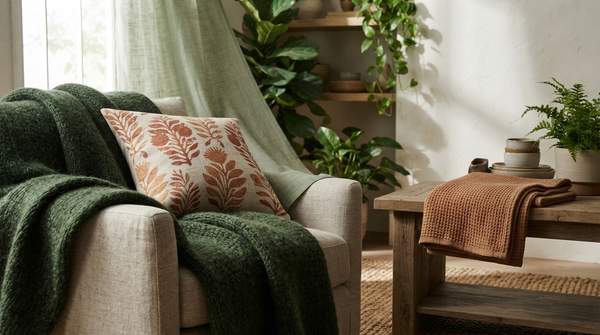
Individual textiles become a biophilic room only when they are layered into a coherent sensory sequence. Ever Lasting's worked example is a bedroom, built in four moves: first, "start with the foundation"—sheets and a duvet cover in a mineral or sky tone such as stone grey or misty blue. Second, "add organic texture" by draping an oversized, chunky linen or organic cotton throw, in sage or terracotta, across the foot of the bed.
Third, incorporate natural pattern—a botanical-print cushion or patterned accent that references leaves or organic forms. Fourth, hold the palette to earthy, ethereal hues—sage green, terracotta, misty blue—which Ever Lasting describes as producing a calming effect. The layering logic transfers to other rooms: in a living space, a wool rug grounds the floor, linen or cotton covers seating, and a botanical-patterned throw or cushion introduces the natural-motif layer. The sequence moves from large breathable surfaces to small textural and patterned accents, so touch variation increases as the eye moves inward.
Considering Sustainability in Textile Choices
Because biophilic design is premised on a relationship with nature, fiber sourcing matters as a principle even though this guide does not offer a full certification manual. The clearest verification tool is the Global Organic Textile Standard. Writing for the fabric retailer Fabric Sight, Roxana Martiniuc explains that GOTS was established in 2002 to set fixed rules for producing sustainable textiles, and that thousands of organic cotton producers, manufacturers, and retailers have since committed to its standards.
Not all certifications carry the same weight. Martiniuc notes that the Recycled Claim Standard (RCS) verifies that products contain at least 5 percent recycled material and that every production phase meets certification requirements—but that RCS "does not consider social or environmental factors." That gap is why, she writes, many textile companies pursue GOTS or the GRS alongside RCS. For a homeowner, the practical shortcut is simple: for organic cotton, look for GOTS; treat recycled-content labels alone as narrower claims.
Comparative Framework for Biophilic Textiles
The table below categorizes the four representative choices by their biophilic contribution, ideal application, key properties, and the certification relevant to each. Read it as a decision matrix: identify the room function and the effect you want—cooling breathability, warming texture, or visual connection—then match the fiber or pattern to that role.
| Textile type | Key biophilic contribution | Best for (room/use) | Key properties | Relevant certification |
|---|---|---|---|---|
| Linen | Natural texture and breathability that evoke natural variation; a tactile connection to nature | Foundational bedding—duvet covers and sheets; chunky throws | Irregular, matte weave; breathable natural fiber | GOTS applies to organic-certified linen production |
| Organic cotton | Natural texture and breathability in a softer, skin-contact form | Sheets and duvet covers as the foundation layer of a bedroom | Soft, breathable, suitable for daily contact | GOTS, established 2002 for organic textile production |
| Wool | Warmth and texture contributing a sensory-rich, grounding quality | Rugs and chunky throws in living spaces and bedrooms | Supple softness; warming tactile presence | Recycled wool may carry RCS; RCS covers recycled content only, not social or environmental factors |
| Botanical prints | Visual analogues of nature—abstract organic forms and layered motifs that add depth | Accent cushions, patterned throws, and drapery as the pattern layer | Mimics leaf forms and natural irregularity rather than rigid geometry | Depends on the base fabric; certification follows the underlying fiber |
The comparison shows the division of labor clearly: linen and organic cotton contribute through texture and breathability and are ideal for bedding foundations; wool contributes through warmth and texture and is ideal for rugs and throws; botanical prints contribute through visual natural analogues and suit accent layers. GOTS remains the relevant certification for organic cotton; recycled-content labels are narrower.
Making Your Biophilic Textile Choices
Select textiles that offer natural textures, patterns, and colors to create a multi-sensory connection to nature within your home. In practice, that means pairing a breathable linen or organic cotton foundation with a warming wool layer and a botanical-patterned accent, held together by an earthy palette of sage, terracotta, stone grey, and misty blue.
The outcome to check for is the visual and tactile harmony of layered natural textiles and patterns in a room, reflecting earthy tones and organic forms. A bedroom assembled this way—mineral-toned sheets, a chunky sage throw at the foot of the bed, a botanical-print cushion—should read as a cohesive, restorative retreat rather than a collection of separate fabrics. If the layers still feel disconnected, the missing element is usually either the unifying palette or the organic-texture middle layer, and either can be added next.
Sources
- 14 Patterns of Biophilic Design — Terrapinbrightgreen
- Biophilic interior design: merging the great outdoors with indoor spaces — Emilceramica
- Biophilic Decor at Home: Textiles That Bring the Outdoors In — Ever Lasting
- Get to know more about sustainable fabrics and certifications — Fabric Sight