Biomimicry in textiles works by a repeatable logic: identify a natural organism that has already solved a performance problem, isolate the structural or process principle behind that solution, and translate it into fiber, coating, or fabric engineering. Three established examples—the lotus leaf, spider silk, and shark skin—show how this chain from natural model to functional principle to finished textile produces properties that conventional fabrication struggles to match: self-cleaning repellency, strength without heat, and drag reduction in water.
Introduction to Biomimicry in Textiles
Biomimicry is the practice of emulating nature to solve human design problems, and the Guardian, surveying the field in 2014, described it as "an emerging science that emulates nature to solve human problems," pointing to Velcro—invented in 1948 and modeled on hooked plant burrs—as its textbook case. What distinguishes biomimicry in textiles from ordinary inspiration is the shift in how things get made: as an overview of the field published in the academic literature observes, in nature "growth is the primary means of 'manufacture' rather than fabrication." That difference matters because it points designers toward materials and processes that operate at ambient temperatures, without solvents, and with local, abundant inputs.
The Biomimicry Institute frames the same idea at the level of whole systems. Its 2020 Nature of Fashion report asked "What would the fashion industry look like if it acted like a natural ecosystem?" and concluded that "decomposition is the missing engine"—that textile waste should be reprocessed into biocompatible materials that can reintegrate into natural cycles. The Institute's work draws on nature's decomposers, bacteria, archaea, fungi, and algae, which have "sustained material flows for millennia."
Key Biomimetic Innovations in Textiles
The clearest way to understand biomimetic design is to decompose each example into its three load-bearing parts: the organism, the principle, and the resulting fabric technology. The table below performs that breakdown for the three established cases, showing how different natural models lead to entirely different functional outcomes—repellency from one, strength from another, and hydrodynamics from a third.
| Natural Model | Biomimetic Principle | Textile Innovation/Application |
|---|---|---|
| Lotus leaf | Superhydrophobicity and self-cleaning: water beads up and rolls off the leaf's microstructured surface, carrying dirt with it | Water- and dirt-repellent, stain-resistant coatings for sportswear, outdoor gear and home textiles |
| Spider silk | Spinning strong, elastic fibers from a liquid protein feedstock at room temperature, without harsh chemistry | Artificial silk filaments—tunable, durable and conceivably biodegradable—produced from commercial protein feedstock |
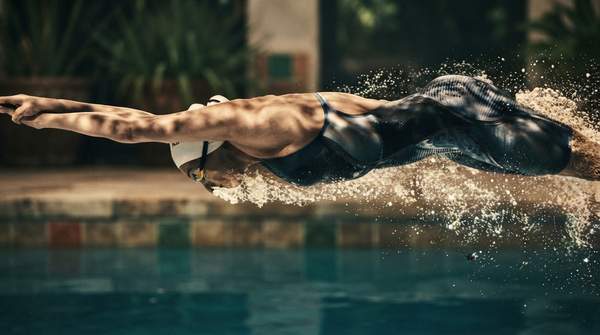
| Shark skin | Drag reduction through dermal denticles that minimize turbulence and friction in water | Speedo's 'Fastskin' swimwear, engineered to reduce drag in competitive swimming |
Read across the rows, the comparison shows why the natural model matters so much: the lotus leaf contributes surface architecture rather than material chemistry, which is why lotus-inspired repellency can be engineered into existing fabrics as a coating. Spider silk, by contrast, contributes a process—low-temperature fiber formation—which changes the sustainability profile of the fiber itself. Shark skin contributes geometry again, but of a kind tuned to fluid flow rather than water repellency.
The Lotus Effect: Self-Cleaning and Water Repellency
The lotus leaf repels water not through chemistry alone but through micro- and nano-scale surface texture: water does not remain on the leaf but "simply beads up and rolls off," as textile research organization Shirley explains, and the rolling droplets collect dirt on the way. Textile engineers applying this principle, as coverage of the field at Textilesphere describes, have developed fabrics with hydrophobic surfaces that repel both water and dirt, targeting sportswear, outdoor gear and home textiles.
A contemporary application shows the principle reaching commercial practice. The UK company Amphico, as Learn Biomimicry reports, mimics the microstructures of lotus leaves and other organisms to create waterproof, breathable, and completely recyclable textiles—designed without harmful PFAS chemicals by replicating water-repelling mechanisms found in nature. The example is instructive because it demonstrates that copying the lotus's surface geometry can replace the fluorinated chemistry that conventional durable water repellents have historically depended on, addressing repellency at the level of structure rather than coating.
Spider Silk: Engineering Lightweight Strength
Spider silk's appeal to textile engineers rests on two facts. First, its mechanical performance: a review of nature-inspired design notes that spider silk "was found to be stronger than steel," while remaining elastic. Second, and arguably more significant for sustainability, is how spiders make it: from a liquid protein feedstock, at ambient temperature, without industrial heat or harsh solvents.
That second fact has driven process-focused imitation. A team at the University of Cambridge produced artificial spider silk from a super-molecular polymer-colloidal hydrogel at room temperature. The most developed commercial expression is Spintex, winner of the Biomimicry Institute's 2021 Ray of Hope Prize, whose filament protrusion process is described as non-toxic, low-water, and low-energy, using readily available commercial proteins as feedstock. The resulting material is tunable and durable, produced at room temperature without harsh chemical agents, with the Institute reporting potential for closed-loop recyclability and indications of both aerobic and anaerobic decomposition—though certain aspects remain in development, so biodegradability is a prospect, not a settled spec.
Shark Skin: Reducing Drag for Performance
Shark skin is covered with dermal denticles—tiny tooth-like structures whose riblet geometry suppresses turbulence as water flows over the surface. The translation into textiles is Speedo's Fastskin swimwear, which Shirley cites as a biomimetic garment that reduces drag in water, allowing the same hydrodynamic trick to be applied to an athlete's covered surface. As a performance case it is the purest of the three: the innovation lies entirely in engineered surface geometry, transferring a swimming adaptation directly into fabric construction for competitive swimming.
Biomimicry's Contribution to Textile Sustainability
The sustainability argument for biomimicry is strongest where it copies nature's processes as well as its forms. Textilesphere's overview of the field argues that biomimicry can lead to more sustainable production "by reducing the use of harmful chemicals and energy-intensive processes," yielding materials that are biodegradable, renewable, and lower in environmental footprint. Spider-silk spinning is the clearest illustration: room-temperature, solvent-free fiber formation replaces the energy-intensive polymerization of conventional synthetics. Amphico's PFAS-free lotus coatings make the same point for repellency.
But the field's own literature warns against equating nature-inspired with eco-friendly. A review in fashion and textile engineering concludes bluntly that biomimicry "might not be eco-friendly"—citing shark-skin-inspired swimwear and artificial spider silk as examples where the bio-inspired product itself does not guarantee environmental benefit. The Velcro case shows why: although the fastener's hook-and-loop geometry came from a plant burr, it has "been traditionally manufactured using nylon," a petroleum derivative carrying the usual environmental consequences of petroleum processing. The deciding factor, that review notes, is the full lifecycle of the product—its material inputs and manufacturing—and it argues that pairing biomimicry with green chemistry, lower processing temperatures, and reduced solvent demand is what "would propel sustainability in a big way."
The Biomimicry Institute's decomposition program extends the logic to end-of-life, working with bacterial, fungal and algal decomposers so that textiles can break down when synthetic materials would persist as pollution.
Embracing Nature's Design for Sustainable Textile Futures
For textile designers and manufacturers, the evidence supports a clear decision: continue exploring and implementing biomimetic principles to develop innovative, high-performance, and environmentally responsible materials—prioritizing the emulation of nature's processes, not just its surface forms, since process imitation is where the room-temperature, solvent-free advantages actually arise. The three deconstructed examples each model the method: adopt the lotus's geometry for repellency, the spider's spinning for low-energy strength, the shark's riblets for drag reduction.
The measurable indicator of progress is increased market availability and adoption of textiles explicitly marketed with biomimetic properties and verified sustainability certifications—concrete products like Amphico's recyclable, PFAS-free lotus-inspired fabric and Spintex's room-temperature silk, counted alongside credible third-party verification rather than nature-themed branding alone.
Sources
- Biomimicry in textiles: past, present and potential. An overview - PMC
- Biomimicry in Textiles | Examples — Textilesphere
- Seven fabrics inspired by nature: from the lotus leaf to butterflies and sharks — the Guardian
- Biomimicry
- Biomimicry: Environmental and Social Responsibility within Textiles — Shirley
- How Biomimicry Enables Sustainable Product Design — Learnbiomimicry
- Nature of Fashion - The Biomimicry Institute
- Lupinepublishers